
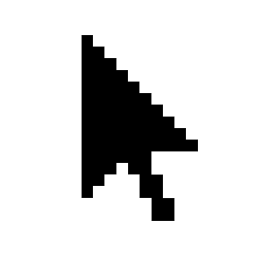
 That we use arrows to point at things may seem so obvious that it doesn’t bear explanation, but it’s worth noting that the arrow as an indicator for direction dates to long, long before computers.
It was used on signage in truncated, unfletched form throughout the 20th and 19th centuries, but was apparently pioneered as an standard, abstract symbol for direction in the 18th century. Before that, it is probable that actual or drawn arrows were used as directional guides and other communications, just not as frequently. Everyone understood which direction an arrow flies, so we understand that the “target” is where the arrow is pointing.
Today, the arrow is a common cursor, along with a pointing finger or manicule. The arrow’s pointed tip allows for pixel-perfect clicks, and as you may notice, the arrow is pointing “away” from the user, specifically their right hand (though there are mirrored variants). The idea is that you are using something pointy with a definite front end to tap on whatever it is you are selecting.
But of course the arrow is also present as a more passive sign or symbol communicating motion (in the direction a real arrow would fly) in countless diagrams and icons — it’s just worth remembering that the similarity between all these and the flying projectile are not coincidental.